The Ghanaian Traditional Wedding: What Actually Happens
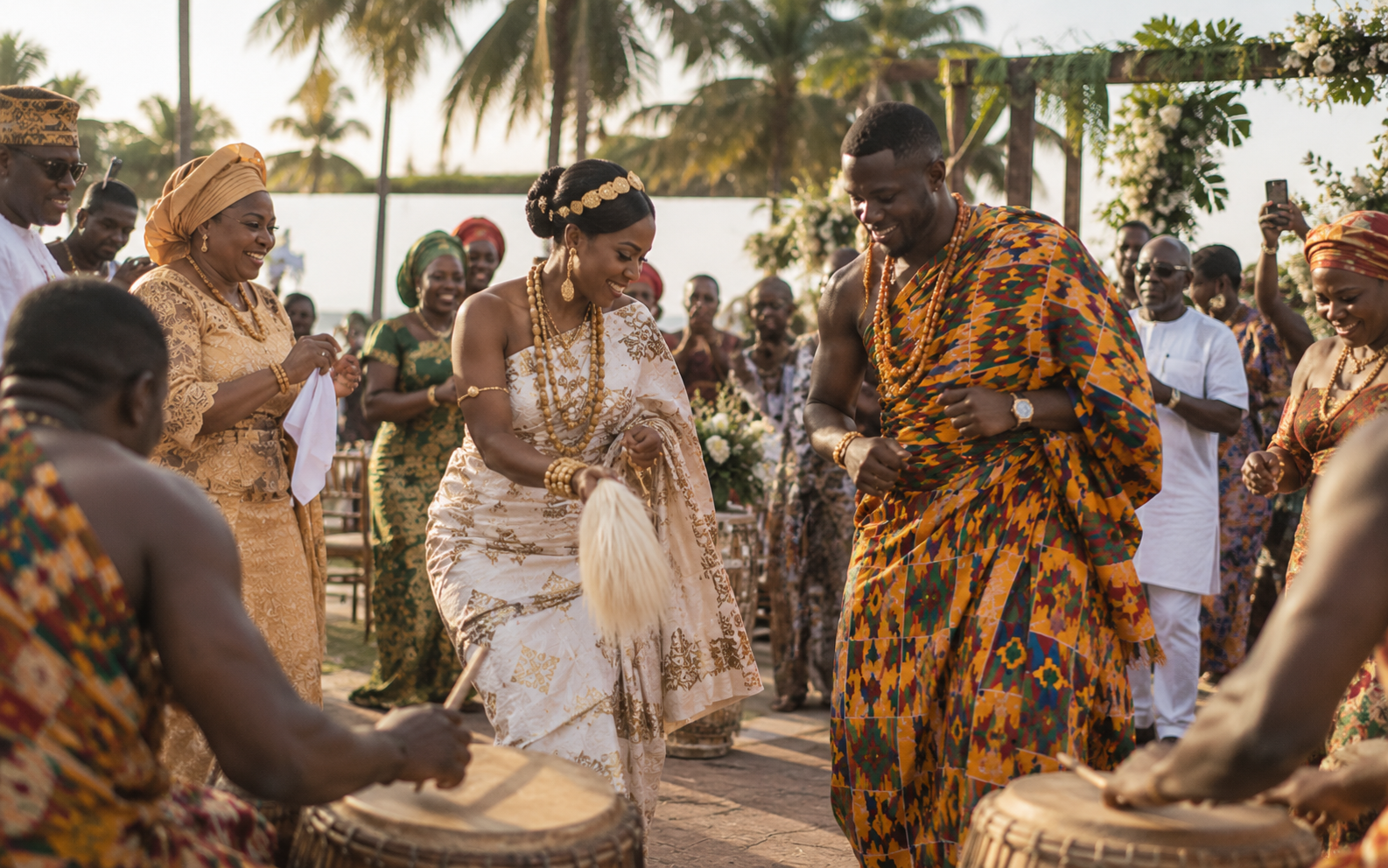
For many Ghanaian couples, the traditional ceremony is the wedding. The white wedding that follows is a celebration of something that has already happened — two families agreeing, in front of witnesses, that a marriage exists.
If you grew up abroad, or you're marrying into a Ghanaian family, this is usually the part of the process that's hardest to picture. It isn't organised the way a reception is. There's no supplier to book it from, and very little of it is written down.
Before anything else: it varies
There is no single Ghanaian traditional wedding. Akan, Ga, Ewe, Dagomba and other traditions each do this differently, and within any of them, two families from neighbouring towns may expect different things.
So treat everything below as the general shape rather than a script. The specifics come from the two families involved, and finding them out early is most of the work.
The shape of the process
Broadly, it runs in three movements:
- The knocking — the groom's family formally approaches the bride's to state their intention.
- The list — the bride's family sets out what is expected.
- The engagement ceremony — the families meet, the items are presented, and the marriage is recognised.
Some families compress these. Others hold them months apart. Knowing which your families expect changes your whole timeline.
The knocking
The knocking is the opening move: a small delegation from the groom's family visits the bride's family to announce the intention to marry. Traditionally this is where permission is sought, not assumed.
It is deliberately modest — a handful of people, not a party. What matters is that it is done properly, by the right people, in the right order. Skipping it, or treating it as a formality to rush, is the kind of thing families remember.
What this means for you: it isn't a vendor event. You don't book it — you arrange it with your elders, and the date usually has to suit them rather than your calendar.
The list
After the knocking, the bride's family provides a list of items to be brought to the ceremony. What's on it varies enormously by tradition, family and circumstance.
Two things are worth understanding.
It isn't a purchase. The items are symbolic — they honour the bride's family and mark the seriousness of the request. Reading the list as a price tag misunderstands what it's for, and that misunderstanding causes a lot of unnecessary friction.
It takes time to gather. Cloth, drinks, jewellery and personal items are sourced from different places, and some are made to order. Families who leave the list late end up paying for haste.
Ask for the list as early as the families are willing to discuss it. It is the single item most likely to delay everything else.
The engagement ceremony
This is the ceremony most people picture: both families present, seated facing each other, dressed in coordinated cloth.
Common threads across traditions include a spokesperson for each family who does the actual talking, the formal presentation and acceptance of the items, the bride being called out — sometimes after the families are playfully offered someone else first — and prayers or libation depending on whether the family is Christian, Muslim or traditionalist.
It's often warm, funny and quite long. The negotiation between spokespeople is half the entertainment.
Who actually speaks
In many traditions neither you nor your parents do the talking. Each family appoints a spokesperson — among the Akan, the okyeame — who speaks on their behalf.
This surprises couples who expect to lead their own ceremony. You are, in a meaningful sense, the subject of the proceedings rather than the host. Ask early who will speak for each side; a good spokesperson makes the day, and they are chosen, not hired.
Cloth
What everyone wears is coordinated, and it isn't decided last.
Kente and other traditional cloth is frequently woven or made to order, and tailoring needs fittings. Families often coordinate cloth across a wider group — aso ebi — so that everyone appears as one party. Agreeing on cloth is a family decision with a long lead time, and it's a common reason couples run late.
If you take one practical thing from this article: start the cloth conversation earlier than you think you need to. Browse traditional wear designers on Bride Ghana →
How this sits alongside a white wedding
Most couples do both. The traditional ceremony comes first — it is the one that establishes the marriage in the eyes of the families — and the white wedding follows, sometimes the next day, sometimes months later.
Doing both close together saves travelling guests a second trip, which matters when much of your family is flying in. It also compresses two sets of attire, two setups and often two caterers into one weekend, which is demanding on everyone. Spacing them out is easier to run but asks more of your guests.
Neither is wrong. Decide deliberately rather than by default, because it drives your budget and your timeline more than almost any other choice. Our cost guide covers what doing both involves.
If you're planning from abroad
This is the part of a Ghanaian wedding that resists remote planning most stubbornly.
Vendors can be shortlisted over WhatsApp. Families cannot be negotiated with over WhatsApp — not well, and not quickly. The conversations that shape the traditional ceremony happen between elders, in person, at their pace.
Two things help. Nominate someone at home who can represent you properly, attend on your behalf and keep things moving. And weight your trip towards the family side: the white wedding is mostly vendors executing what you already agreed, while the traditional ceremony needs you present.
More on what to settle remotely in our diaspora planning guide.
Questions to ask your families early
The answers determine your timeline, so ask before booking anything.
- Do we hold the knocking and the engagement separately, or together?
- Who speaks for each family?
- When can we expect the list?
- Is there cloth the family expects everyone to wear, and who arranges it?
- Are we expected to hold the ceremony in a particular place — a family house, a hometown?
- How are prayers handled if the two families practise differently?
- Who, on each side, must be present for the date to work?
That last one catches more couples than any other. A date that suits you and your vendors but not a key elder is not a date.
Frequently asked questions
Is the traditional ceremony legally binding? Customary marriage is recognised in Ghana, though registration is a separate step. Confirm what applies to your situation — it matters for visas and for name changes abroad.
Can we skip the traditional ceremony? Some couples do. Whether that is acceptable is a family question rather than a practical one, and it's better raised early than assumed.
Who pays for what? This varies by tradition and family, and it is worth agreeing explicitly rather than inferring. Ambiguity here is where tension tends to build.
Do we need vendors for the traditional ceremony? Usually fewer than for a white wedding — often a photographer, cloth and tailoring, catering, and decor if it's held at a venue rather than a family house.
How far ahead should we start? Earlier than the white wedding. The family conversations and the cloth are the long poles, and neither can be rushed by paying more.
Getting started? Browse verified vendors on Bride Ghana → — every one reviewed and approved before their listing goes live.